




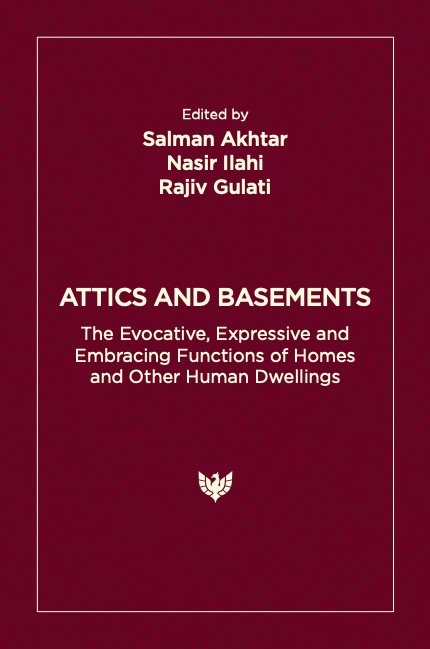
Attics and Basements: The Evocative, Expressive and Embracing Functions of Homes and Other Human Dwellings
Book Details
- Publisher : Karnac Books
- Published : January 2026
- Cover : Paperback
- Pages : 208
- Category :
Psychoanalysis - Catalogue No : 98448
- ISBN 13 : 9781800134201
- ISBN 10 : 1800134207
Also by Salman Akhtar

Also by Rajiv Gulati
save £2.80
Free UK Delivery over £25

save £5.00
save £20.99
Free UK Delivery over £25


There are currently no reviews
Be the first to review

Attics and Basements investigates all manner of homes. Its approach is fundamentally psychoanalytic but borrows significantly from anthropology, history, architecture, religion, and general psychiatry. This rich mixture results in a deep understanding of the intertwined relationship between one’s internal world and external reality.
Our relationship with ‘home’ includes many psychosomatic realms: perception, imagination, fantasy, projection, separateness, boundaries, smells, and sounds. Our very first home is our mother’s womb; our very last, an urn or coffin. In between, we have our childhood home, deeply incorporated into our psyche, which persists, throughout life, as (hopefully) a fond prototype, an object of nostalgia, and a source of ego-replenishment, college dorms, shared housing, apartments, marital and family homes, downsized residences of late middle age, retirement homes, nursing homes, and hospices. Far apart from a world of linear progression are traumatizing homes, foster homes, and orphanages where searingly painful as well as defiantly triumphant scenarios of growth and development may unfold. Also, monasteries, which embody the human desire for detachment, silence, and contemplation, away from earthly relations to seek spirituality and transcendence.
The contributions from Aisha Abbasi, Salman Akhtar, Rajiv Gulati, M. Nasir Ilahi, Gurmeet S. Kanwal, Murad Khan, Milan Patel, Sarita Singh, and Nidhi Tewari seek to demonstrate that at each step in the life span, our dwellings both impact upon and reflect our intrapsychic goings-on. As well as examinations of the kinds of home mentioned above, the abstract nature of home is also explored, looking at its function, the search for a sense of home, homesickness, absence, nostalgia, and the development of a stable internalized home. There’s no place like home and Attics and Basements shows us why.
Reviews and Endorsements
‘This wide-ranging and profound book on homes and other human dwellings is well worth a read and a re-read. It is comprehensive in what it covers: childhood homes, marital homes, nostalgia for lost homes, orphanages, retirement homes, monasteries, and much more. Along with such breadth, the book delves deeply, through historical reportage and psychoanalytic deconstruction, into the external realities it considers and the internal state of affairs they embody and represent.’
Joseph Fernando, MD Training and Supervising Analyst, Toronto Institute of Psychoanalysis, author of A Psychoanalytic Understanding of Trauma
‘From the womb to the cemetery, this timely book explores the multiple facets of home. The three-year-old girl plays house, acting out all the characters in her family. The oedipal child makes forts out of pillows and blankets. The latency child decorates the room with multiple collections, dreams of growing up, and the adolescent isolates herself in her room where fantasies of leaving and building one's own home seem both exciting and terrifying. This book contains all this and much more. It is extremely important at a time when so many in our country might lose their homes!’
Ann Smolen, PhD Training and Supervising Analyst, Psychoanalytic Center of Philadelphia, author of Six Children: The Spectrum of Child Psychopathology and Its Treatment
‘Attics and Basements explores the multi-layered meanings of the notion of “home,” from our bodily beginnings in the womb and infancy to the challenges of old age and death, from the development of a sense of internal stability to existential threats. The book explores actual physical locations, the challenges of homelessness, and the notion of a secure base. In addition, the volume is infused with poetry, both in the use of language in the chapters themselves, and in the multiple references to poets and their creations – Rumi, Bachelard, T. S. Eliot, and Akhtar himself. This is a gem of a book, a pleasure both to read and digest.’
Dr. Julian Stern, Consultant Psychiatrist and Psychoanalyst, London, UK, Former Director, Adult and Forensic Services, Tavistock and Portman NHS Foundation Trust
Table of Contents
Acknowledgments
About the editors and contributors
Introduction
Introductory overview
1. The nature and functions of a home
Nidhi Tewari
Real and imaginary homes across the human life span
2. The biography of a home
Nidhi Tewari
3. The search for a sense of home
Sarita Singh and Rajiv Gulati
4. Homesickness, nostalgia, and the development of a stable internalized home
Aisha Abbasi
5. Home, bitter home
Gurmeet S. Kanwal
6. Orphanages and foster homes
Milan Patel
7. Monasteries
Salman Akhtar
8. Retirement homes, nursing homes, and hospices
Murad Khan
9. Dwellings and absences thereof, within and without
Nasir Ilahi
Concluding commentary
10. Finally, a turn to poets
Salman Akhtar
References
Index
About the Editor(s)
Salman Akhtar, MD, is professor of psychiatry at Jefferson Medical College and a training and supervising analyst at the Psychoanalytic Center of Philadelphia. He has served on the editorial boards of the International Journal of Psychoanalysis and the Journal of the American Psychoanalytic Association. His more than 450 publications include 120 books, of which the following twenty-three are solo-authored – Broken Structures (1992), Quest for Answers (1995), Inner Torment (1999), Immigration and Identity (1999), New Clinical Realms (2003), Objects of Our Desire (2005), Regarding Others (2007), Turning Points in Dynamic Psychotherapy (2009), The Damaged Core (2009), Comprehensive Dictionary of Psychoanalysis (2009), Immigration and Acculturation (2011), Matters of Life and Death (2011), Psychoanalytic Listening (2013), Good Stuff (2013), Sources of Suffering (2014), No Holds Barred (2016), A Web of Sorrow (2017), Mind, Culture, and Global Unrest (2018), Silent Virtues (2019), Tales of Transformation (2022), In Leaps and Bounds (2022), and In Short (2024) – as well as sixty-nine edited or coedited volumes in psychiatry and psychoanalysis. Dr. Akhtar has delivered many prestigious addresses and lectures including, most significantly, the inaugural address at the first IPA-Asia Congress in Beijing, China (2010). Dr. Akhtar is the recipient of the Journal of the American Psychoanalytic Association’s Best Paper of the Year Award (1995), the Margaret Mahler Literature Prize (1996), the American Society of Psychoanalytic Physicians’ Sigmund Freud Award (2000), the American College of Psychoanalysts’ Laughlin Award (2003), the American Psychoanalytic Association’s Edith Sabshin Award (2000), Columbia University’s Robert Liebert Award for Distinguished Contributions to Applied Psychoanalysis (2004), the American Psychiatric Association’s Kun Po Soo Award (2004), the Irma Bland Award for being the Outstanding Teacher of Psychiatric Residents in the country (2005), and the Nancy Roeske Award (2012). He received the Sigourney Award (2013), which is the most prestigious honor in the field of psychoanalysis. Dr. Akhtar is an internationally sought speaker and teacher, and his books have been translated in many languages, including German, Turkish, and Romanian. His interests are wide and he has served as the film review editor for the International Journal of Psychoanalysis, and is currently serving as the book review editor for the International Journal of Applied Psychoanalytic Studies. He has published eighteen collections of poetry and serves as a scholar-in-residence at the Inter-Act Theatre Company in Philadelphia. His Selected Papers (Vols I–X) were recently published and released at a festive event held at the Freud House & Museum in London.
M. Nasir Ilahi is a training and supervising analyst at the Psychoanalytic Association of New York (PANY), affiliated with NYU Medical School. He is a fellow and graduate of the British Psychoanalytical Society and an honorary member of the New York Psychoanalytic Society and Institute. He is an editorial board member of the International Journal of Psychoanalysis and chair of the board of directors of Psychoanalytic Electronic Publishing (PEP). He has authored, and lectured internationally, in areas dealing with primitive mental states/non-neurotic aspects of disturbance, and the role of internalized culture in theory and practice.
Rajiv Gulati, MD, is a training and supervising analyst at the Psychoanalytic Association of New York (PANY) and maintains a private psychoanalytic practice in Brooklyn. Born in New Delhi, Dr. Gulati has a strong interest in the ways in which culture inflects the experience of selfhood and crops up in the normative discourses that police gender and sexuality. He coedited the book, Eroticism (2021), with Dr. Salman Akhtar. He was the recipient, with coauthor David Pauley, of the APsA Committee on Gender and Sexuality’s 2020 Ralph Roughton Paper Award for “Reconsidering Leonardo Da Vinci and a memory of his childhood,” published in the Journal of the American Psychoanalytic Association.
Customer Reviews
Our customers have not yet reviewed this title. Be the first add your own review for this title.
You may also like


Inside Psychosis: A Clinical and Therapeutic Exploration of Working on Male and...
Helen L. Holmes
Price £31.99

Eyes, Mind and Vision: Visual Realities and Metaphors in Psychoanalysis
Salman Akhtar
Price £31.49
save £3.50