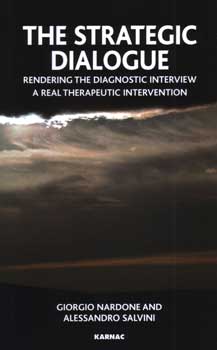




The Strategic Dialogue
Reviewed by Claudette Portelli
In the wake of more than twenty years of clinical research experience at the Centro di Terapia Strategica (CTS) of Arezzo, Giorgio Nardone and his collaborators have come to understand that in most cases, concealed behind a request for therapeutic help, is an underlying tacit demand, which reads, "Change me without changing me." This double-bind request induced these clinicians-researchers to search for innovative means of intervention, to help patients overcome the constrains that often block them from undergoing the desired change (Nardone & Portelli 2005).
In light of this important notion, the latest evolution of advanced brief strategic therapy (BST) has revolved around the use of strategic dialogue, a therapeutic technique which aims at turning the first encounter with the patient from being merely a diagnostic interview into a discriminating-intervening process. Through a seemingly simple and thus disarming dialogue, the first session becomes a complete and effective therapy in itself.
As Paul Watzlawick denotes in the preface of this book, the therapeutic power of the strategic dialogue resides in fact in its "surprising essentiality", in guiding persons entrapped in their problems to come to jointly discover, with the therapist, the solution in a sort of natural and spontaneous evolution through the use of a simple therapeutic conversation. Through the use of an elaborated yet subtle communicative expedient, the patient feels himself to be the main protagonist and artifact of the therapeutic process, thus becoming more inclined to follow the given in-session and/or out-session indications that bring about change.
Yet the use of this rhetorical device as a strategic technique is no new discovery, in fact it holds its roots in the history of civilization. Nardone and Salvini present an excursus of the use of the dialogue through out the history of mankind, to reveal the power of this instrument as the most used rhetorical artifact in the history of human reason and its divulgence. The most famous thinkers and leaders have managed to spread their ideas and convince others of their value, even when faced by great opposition, by using persuasive expedients.
Yet it is worth noting that the first person to use dialogue as a persuasive technique, was Protagoras. Regarded as the principle exponent of the great Sophists of the ancient Greek era, he made use of the so-called Eristic dialogue (eristik tchne, i.e., the art of argumentation) to persuade his interlocutors of his thesis (Abbagnano 1993). The art of this dialogue was founded more on putting forward questions rather than that of proposing affirmations. Questions were structured in succession aimed at acquiring responses from the interlocutor, who is in this way guided to discover alternatives through the use of the wisely chosen questions. The questioning process guided the interlocutor to doubt his previous assumptions and to start considering the new point of view suggested by the other. This reduces resistance to change, since the interlocutor feels that he is the main protagonist of the new thesis.
The authors reveal how the dialogue was used by St Thomas of Aquinas and Blaise Pascal in persuading their followers of their theological arguments and how Galileo and Einstein employed it to propose their scientific theses to the public. Moreover, the dialogue was the investigative technique used by most psychotherapies for a better understanding of the psyche and of human behavior. Brief strategic therapy regards the dialogue as a fundamental investigative and intervening instrument in the resolution of human sufferings.
In his clinical practice, the therapist is not only faced by great human suffering, but paradoxically his work is often challenged and sabotaged by the patient's resistances to change. Even though patients are in desperate need to be helped, often they do not or are not able to collaborate and follow the therapist's indications. In fact research reveals that less than 20% of the patients are actually collaborative and put into play their resources to undergo change (Nardone & Watzlawick 2005).
Aware of these difficulties, brief strategic therapy has worked hard to overcome this limitation, directing its clinical-empirical research not only towards understanding human suffering and its function but also to unveil adequate means to overcome the person's resistance to change. In fact, the latest evolution of advanced brief strategic therapy revolves around the first session and the use of strategic dialogue.
Hence, during these years of clinical-intervention research, Nardone and his collaborators have striven to formulate a particular process of change-oriented questioning that can help therapists guide each patient through a process of learning that will provide him with the impression of having reached certain conclusions by himself, even though those conclusions have actually been subtly induced by the therapist. This is in line with the Spanish Jewish philosopher and poet Solomon Ibn Gabirol's words, "A wise man's question contains half the answer."
In the advanced model of BST, the first session has a fundamental importance because it embraces the first and second stages of the therapeutic process. In other words, during the first session the strategic therapist does not limit his intervention to a mere capturing of the patient and of trying to discriminate or define the type of pathology the patient presents, but he does already start introducing change. This is carried out through the use of a particular type of semi-structured interview based on the strategic dialogue.
Thus, one can define the strategic dialogue as an intervening and discriminating instrument that involves the language used, the relationship established, and the logic of the intervention, and is characterized by its all-time orientation toward change.
The BST model used in all CTS-affiliated clinics from 1987 to 1995, comprised open-ended questions that followed a more directive manipulative logic of intervention. Resistance to change was overcome with a highly suggestive, hypnotic directive intervention, where the prescription was the apex of the session. With this approach it took two to three sessions to have a more comprehensive description of the perceptive-reactive system of the patient, to tune-in with the patient and overcome his resistance, and thus be able to choose the adequate unblocking intervention that triggers change.
In the advanced model of BST all this takes place in the first session, by means of a more indirect and subtle mode of intervention. Even though both models share the same objective, the process of arrival changes.
By adopting the strategic dialogue, the therapist seems to take up a one-down position, where he humbly asks the patient, who feels in command of the dialogue, a series of seemingly simple questions, but actually this method leads the patient to lower his resistance, to become open to new alternatives discoveries, useful for solving his problem.
The strategic dialogue with its change-oriented questions, its continuous redefining, paraphrasing, and the use of analogical language (metaphors, aphorisms, anecdotes, etc) that evoke overwhelming sensations in the session, triggers off a persuasive process through which the patient gradually comes to recognize himself in the new vision suggested by the therapist, while feeling, however, as if he was the one to reach this new vision.
The harmonious evolution of the strategic dialogue does not only cause the suggestions given by the therapist to be more acceptable to the patient but they are consequently perceived as some sort of inevitable continuation of the process in progress. In fact, the art of therapy is that of rendering change, not just as a desired goal but inevitable outcome (Nardone & Salvini 2004).
Through this gradual process of strategic interaction, which follows the lines of Protagoras's sophistic skill and the rhetoric of Blaise Pascal, the strategic therapist leads the person along a path of guided self-discovery, thus increasing their level of persuasion. Indeed, according to Pascal (1995), "People are generally better persuaded by the reasons which they have themselves discovered than by those which have come into the mind of others."
The strategic dialogue leads to a joint discovery. This helps in establishing a "good" therapeutic relationship and in strengthening extra-therapeutic elements that tend to magnify both the efficiency and efficacy of therapy. Research findings show that change is more likely to be long-lasting in patients who attribute their changes to their own efforts (Lambert & Bergin 1994).
The strategic dialogue has turned the first session into a fundamental part of the advanced brief strategic model, because, besides helping in capturing the patient and identifying the problem with greater precision, it is a mediator of small yet fundamental change. The strategic dialogue is a vehicle that induces the patient to "feel" the need to change. Thus, we can conclude by saying that the strategic dialogue is the most elegant and evolved persuasive technique that transformed a simple investigative session into an authentic medium of change.
The authors present the Strategic Dialogue process as a sort of "interactive dance", where questions create answers and answers lead to the formulation of successive strategic questions, thus bringing the interlocutor to take up a new more functional position, acquired by the discoveries made during the dialogue.
The strategic dialogue has been proven to be a useful instrument for problem solving. It presents as a unique vehicle which can be employed effectively and efficiently in various contexts by caregivers and also by anyone dealing with human suffering, individual and interpersonal conflicts, and in overcoming organisational and school-related problems.
This text is enriched by the presentation of full transcriptions of various cases with different problems. These case examples will help the reader immerse themselves more fully into Giorgio Nardone's style of work, to be fascinated by the articulate dialogue carried out through the use of precise strategic plans that are adaptable both to the structure of the problem and also to the peculiar reality of the patient. Moreover the reader will be astounded to discover how through the use of seemingly simple, subtle communicative maneuvres, patients are gently lead to rapid, and effective therapeutic change.
References
Abbagnano, N. (1993). Storia della Filosofia. Turin: Utet.
Boorstin, D. J. (1983) The Discoverers: A History of Man's Search to Know his World and Himself. New York: Random House.
Elster. J. (1979) Ulysses and the Sirens. Cambridge, UK: Cambridge University Press.
Hellman, H. (2001) Great Feuds in Medicine: Ten of the Liveliest Disputes Ever. Chichester: John Wiley.
Lambert, M. J., & Barley, D. E. (2001), Research summary on the therapeutic relationship and psychotherapy outcome. Psychotherapy: Theory, Research, Practice, Training, 38: 357-61.
Lambert, M. J., & Bergin, A. E. (1994), The effectiveness of psychotherapy. In A. E. Bergin & S. L. Bellack (Eds), Issues in Psychotherapy Research (pp. 313-59) New York: Plenum Press.
Nardone, G. (2004). Constructivist theory and therapy. In: J. Sommers-Flanagan & R. Sommers-Flanagan, Counseling and Psychotherapy Theories in Context and Practice (pp. 376-392). Chichester: John Wiley.
Nardone, G., & Portelli, C., (2005) Knowing through Changing: The Evolution of Brief Strategic Therapy. Bancyfelin, UK: Crown Publishing House.
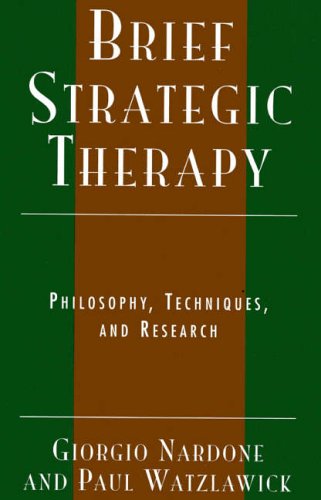
Nardone, G., & Watzlawick. P., (2005) Brief Strategic Therapy: Philosophy, Technique and Research. Northvale, NJ: Jason Aronson
Nardone, G., Verbitz, T., & Milanese, R. (2007). The Prison of Food. London: Karnac.
Pascal, B. (1670), PensŽes [Reprinted Harmondsworth, UK: Penguin, 1995, Translated by A.J. Krailsheimer]. [Italian version: Pensieri Turin: Einaudi, 1962]..