




Jacques Lacan
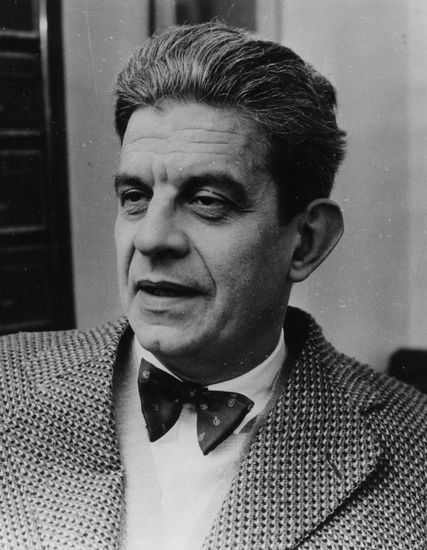
Jacques Lacan (1901-1981) came to psychoanalysis by way of medicine and psychiatry. In 1951 he turned his attention to the training of analysts, and this was one of the issues which led him and his circle to part company with the Société Psychanalytique de Paris. He became, in 1953, the first President of a new group, the Société Française de Psychanalyse, whose declared aim was a return to the true teaching of Freud. Eleven years later the Société Française was dissolved and, under Lacan's direction, gave birth to the École Freudienne de Paris. Jacques Lacan was a practising psychoanalyst and teacher up until his death in 1981.

Desire and its Interpretation: The Seminar of Jacques Lacan Book VI
What does Lacan show us? He shows us that desire is not a biological function; that it is not correlated with a natural object; and that its object is fantasized. Because of this, desire is... (more)

Talking to Brick Walls: A Series of Presentations in the Chapel at Sainte-Anne Hospital
'I've been talking to brick walls,' says Lacan, meaning: 'Neither to you, nor to the Big Other. I'm speaking by myself. And this is precisely what interests you. It's up to you to interpret me.' ... (more)

The Sinthome: The Seminar of Jacques Lacan, Book XXIII
'Ten times, an elderly grey-haired man gets up on the stage. Ten times puffing and sighing. Ten times slowly tracing out strange multi-coloured arabesques that interweave, curling with the meanders... (more)
The Seminar of Jacques Lacan III: The Psychoses, 1955-56
Examines the distinction between the neuroses and the psychoses, with particular reference to the case of Daniel Paul Schreber.
The Seminar of Jacques Lacan VII: The Ethics of Psychoanalysis, 1959-60
Includes discussion of the problem of sublimation, the paradox of jouissance, and the essence of tragedy.
On Feminine Sexuality, the Limits of Love and Knowledge - Encore 1972-1973: Seminar XX
An annotated translation of Jacques Lacan's seminar weighing up theories of the relationship between the desire for love and the attainment of knowledge. The text draws upon the work of such diverse... (more)

Ecrits: A Selection
Jacques Lacan has had a major influence on contemporary discourse. This translation of selected writings from his famous work offers access to nine of his most significant contributions to... (more)
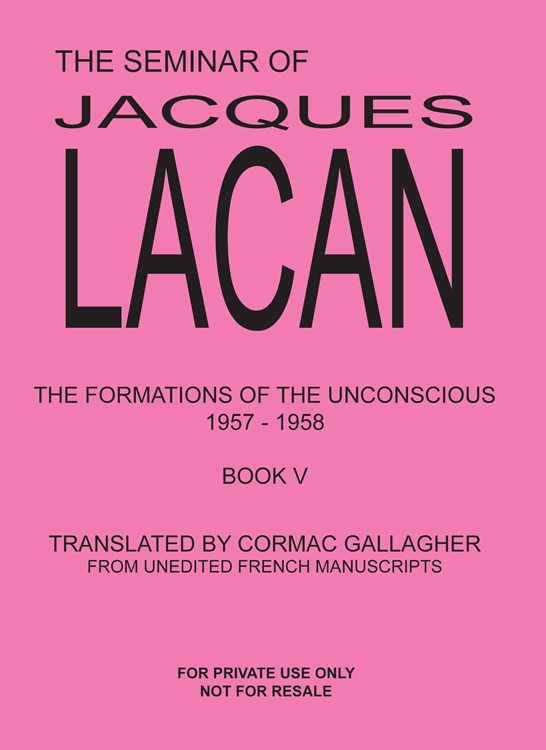
The Seminar of Jacques Lacan V: The Formations of the Unconscious
From unedited French manuscripts
Television: A Challenge to the Psychoanalytic Establishment
The main text is a transcript of a provocative filmed interview with Lacan. The interviewer, J-A Miller, poses questions often asked by those outside the Lacanian mileau. The second half contains... (more)
Ecrits: A Selection
New edition in the 'Routledge Classics' series. Includes papers on the mirror phase, the function of language, the role of the phallus, and many other key Lacanian concepts. 376 pages. (more)
The Seminar of Jacques Lacan I: Freud's Papers on Technique, 1953-54
Includes discussion of the role of the imaginary, resistance, the ideal ego and ego ideal, and the function of speech in psychoanalysis.
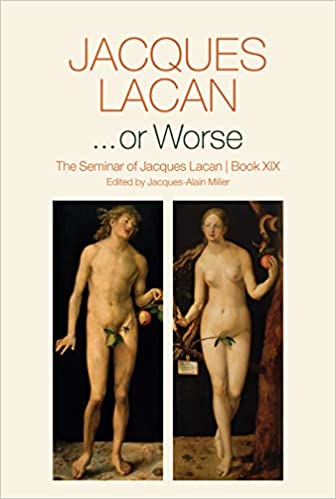
...or Worse: The Seminar of Jacques Lacan, Book XIX
"A chance meeting of a sewing machine and an umbrella. The impossible face-off between a whale and a polar bear. One was devised by Lautréamont; the other punctuated by Freud. Both are memorable. Why... (more)
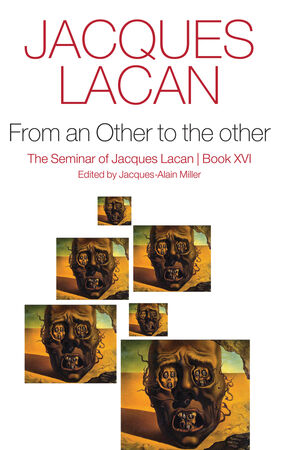
From an Other to the other, Book XVI
Sollers once wrote that, to him, Claudel was first and foremost the man who wrote, “Paradise is around us at this very moment, all its forests attentive like a great orchestra that invisibly adores... (more)
My Teaching
Bringing together three previously unpublished lectures presented to the public by Lacan at the height of his career, and prefaced by Jacques-Alain Miller, My Teaching is a clear, concise... (more)

First Writings
Before he became an analyst, Lacan was a psychiatrist. The articles in the present volume would not be being republished if they didn’t invite us to read them retroactively. What can they teach us... (more)