




The Struggle to be Known: Authority and Experience in Families and Institutions
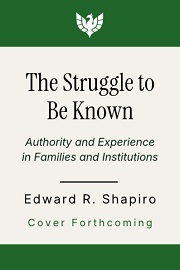
Book Details
- Published : July 2027
- Cover : Paperback
- Pages : 200
- Category :
Forthcoming - Category 2 :
Psychoanalysis - Catalogue No : 98726
- ISBN 13 : 9781800135390
- ISBN 10 : 1800135394
Also by Edward R. Shapiro
save £5.00
Free UK Delivery over £35



There are currently no reviews
Be the first to review

Drawing on more than fifty years as a psychiatrist, psychoanalyst, and institutional leader, Edward R. Shapiro asks why people speaking up so often changes nothing – and what it takes to change how authority is exercised in these situations. He shows how easy it is to overlook what others know, especially when it unsettles what you already believe.
A child knows what it is like to be raised by her parents. A nurse knows a patient in ways the doctor does not. An employee sees what a decision does to the work but has no power to change it. Each may recognize something the people in charge have missed. Yet, speaking up so often changes nothing. What has to happen for it to have an impact?
In The Struggle to Be Known, psychiatrist and psychoanalyst Edward R. Shapiro draws on more than fifty years of work with families, hospitals, a law firm, a university department, and the Austen Riggs Center, which he led for twenty years. He utilises systems psychodynamics to examine how unconscious feelings, roles, authority, and organizational structure shape what people can recognize and do together. He shows how an individual’s standing shapes what they can see, and why those with greater authority may dismiss what others know, in particular when it unsettles their existing beliefs.
Shapiro is often the person in authority in these stories. He describes a consultation in which he learned that his own leadership had become part of the problem. He returns to a young woman he treated in the 1970s, who found her family’s story in a bookstore nearly thirty years later and whose questions led him to change what he had written about her.
One question runs through the book: “How are they right?” It asks us to look for what another person knows, even when their account is shaped by projection or self-interest. It can lead to a harder question, “How am I wrong?” That is a fragile place to learn. Shapiro also asks what people in authority owe in return. Those who speak need an answer: what was heard, what was missed, and what was done. Sometimes the answer means changing who works together, where information goes, and who can act on it. In an epilogue, he carries the question to a nation, through Australia’s 2023 referendum on a First Nations Voice to Parliament.
For clinicians, consultants, and leaders, and for anyone who has spoken up and watched nothing change, The Struggle to Be Known explores how people’s experiences can change the understanding and decisions of those with authority over their lives.
Table of Contents
Author’s Note
Acknowledgements
About the Author
Introduction
Part I: Families
1. When Talking Changes Nothing
2. The Family as First Organization
3. When the Child Carries the Family
4. When the Family Begins to Hold
5. We Bring Our Families with Us
Part II: Organizations
6. Knowledge in Role: The Treatment Unit
7. When No One Has to Answer: The Hospital
8. Authority Under Examination: A Consultation
9. When the People Who Decide Are in the Room: A Law Firm
10. Who Can Speak for the Institution? — A University Department
Part II Conclusion: Learning and Leadership
Part III: The Institution and Its World
11. What We Represent
12. When the Third Changes
13. What Training Teaches Us to See
14. Seeing Through Different Eyes
15. Learning from What We Represent
Epilogue: The Needed Stranger
Source Notes
References
Index
About the Author(s)
Edward R. Shapiro, MD, was the Medical Director/CEO of the Austen Riggs Center from 1991 to 2011. A board-certified psychiatrist, psychoanalyst, family researcher, and organisational consultant, he is also Clinical Professor of Psychiatry at Yale University School of Medicine and Principal of the Boswell Group. A founding member of the Psychoanalytic Society and Institute of the Berkshires, Dr Shapiro is a training and supervising analyst. An organisational consultant for over thirty-five years, Dr Shapiro has consulted with hospitals, mental health clinics, law firms, and family businesses. He has published over fifty articles and book chapters on human and organisational development, family functioning, and personality disorders, presenting papers in this country and abroad. His book (with A. W. Carr), Lost in Familiar Places: Creating New Connections between the Individual and Society, was published by Yale University Press as was his edited book, The Inner World in the Outer World. A Distinguished Life Fellow of the American Psychiatric Association, he is also a fellow of the A. K. Rice Institute and the American College of Psychoanalysis. Dr Shapiro has received the Felix and Helene Deutsch Scientific Award from the Boston Psychoanalytic Society, the Research Prize from the Society for Family Therapy and Research, and the Philip Isenberg Teaching Award from McLean Hospital. In 2007, he was named Outstanding Psychiatrist for Advancement of the Profession by the Massachusetts Psychiatric Association and since 2011 has been on US News & World Report’s list of “Top Doctors”.
Customer Reviews
Our customers have not yet reviewed this title. Be the first add your own review for this title.
You may also like

The Psychoanalyst as Revolutionary: And Other Distinguished Characters
Alan Michael Karbelnig
Price £25.59
save £6.40
Queer Therapy: A Framework for Working With Queer Clients
Thomas Quinn-Smithson
Price £19.99
save £5.00

The Unconscious and the Family: The Psychoanalysis of Links and Transpersonal...
Anna Maria Nicolo
Price £36.99
Psychoanalytic Perspectives on Couples, Families, and Social Change:...
Cristina Calarasanu
Price £36.99