



Recognising Dissociation
Dissociation is a defence mechanism that helps some people survive chronic trauma, and can be the result of ongoing and extreme abuse in early childhood. The person's senses of identity, reality, and continuity become disconnected from each other. Dissociative experiences occur on a continuum, and at the less severe end would include the experience of the victim of an attack who feels that she or he is watching the attack rather than experiencing it. At the most severe end of dissociative experiences, there is dissociative identity disorder (DID), formerly known as multiple personality disorder. Dissociative identity disorder involves the presence of two or more distinct identities or personality states, each with its own relatively enduring pattern of perceiving, relating to, and thinking about the environment and self. At least two of these identities or personality states recurrently take control of the person's behaviour.
In April 2008, there was a major conference in the Netherlands entitled Chronic Traumatization: Disrupted Attachment and the Dissociative Mind. The conference was the largest gathering to date in Europe to discuss dissociation, and was attended by more than 500 clinicians and researchers from all over the world. It attracted so much interest that a further 200 potential delegates could not get tickets because the conference was oversubscribed. In 2004, Ellert Nijenhuis, a keynote speaker at the conference, received from Queen Juliana the Knight of the Order of the Dutch Lion, a very high and rarely given distinction in the Netherlands. Her Majesty wished to honour him as an inspired scientist and clinician in the area of chronic traumatization. This shows how seriously dissociative experiences are taken in the Netherlands, which is today the European centre of clinical, neuropsychological and psychotherapeutic research into dissociation.
In comparison, in the United Kingdom dissociation as a result of chronic trauma is not so widely understood. Fifty-five delegates from the United Kingdom attended the Netherlands conference, representing the relatively small group of psychotherapists, counsellors, and researchers in this country who are working in this field. Unfortunately, within most psychotherapy or counselling trainings, and within social work, medicine, and psychiatry, there is almost no teaching on working with dissociation or dissociative disorders. Indeed, the British Journal of Psychiatry has published only a handful of papers on the topic. This lack of knowledge has a direct impact on the clinical treatment offered to patients, prompting the National Association for Mental Health (MIND) to state,
Mental health professionals receive insufficient training on dissociative disorders and may not ask the right questions during assessment...Lack of knowledge and information may lead to misdiagnosis, particularly when people are describing symptoms that are common to other mental health problems, such as depression...Some people, who have been in contact with mental health services for years, have made astounding progress once dissociative distress was recognised and treated.
Since knowledge of dissociation is not widely available, specialist expertise in this field is also rare in the UK, with only a few centres specialising in work with patients with dissociative disorders. One of them is the Clinic for Dissociative Studies, a small specialist outpatient mental health service for children and adults from all over the United Kingdom suffering from the range of dissociative disorders. As an independent clinical provider to the National Health Service, all assessments and treatments undertaken by the Clinic are wholly funded by the NHS and Local Authorities.
Clinical studies have consistently linked dissociative symptoms with insecure or disorganised attachment patterns of behaviour and thinking. Such patterns, arising from early trauma, can best be worked on if the patient is able to develop and experience a secure attachment in the psychotherapeutic relationship. The client is enabled to deal with past attachment traumas and begin to work through their experience of abuse. The Clinic Director, Valerie Sinason, and Consultant Psychotherapists, Adah Sachs and myself, have a strong foundation in attachment theory and research and we are all registered members of The Bowlby Centre. Valerie Sinason states in Forensic Aspects of Dissociative Identity Disorder, "More important than anything else, love and positive attachments are the keys for any hope and change."
The Clinic's model of treatment varies according to the severity of the trauma and predicament of the patient. Treatment offered, whilst psychoanalytically-based, is tailored to suit the individual client and can include a mixture of therapies. At the extreme end of dissociative identity disorder, treatment involves a team approach with a key psychotherapist assigned for the patient plus a support team. This avoids secondary traumatisation to the psychotherapist and gives the patient access to a wider range of relationships. In some cases, the Clinic provides (and supports and supervises) a local therapist in addition to providing a consultant clinic psychotherapist. Experience at the Clinic means that the patient can be treated by a team in which splitting is minimised and the different fragments of overwhelming experience can be held by the different Clinic members in a way that allows the possibility of hope.
Psychotherapeutic work with people suffering from dissociative disorders raises complex issues and, especially for clinicians working in private practice, the work can feel very challenging and isolated. For example, the complexity of the therapeutic relationship can be understood when thinking about the role of crime in the traumatic personal history of most people with DID: crimes that they have endured, crimes that they have witnessed and crimes that they have committed themselves. As I explain in Forensic Aspects of Dissociative Identity Disorder, in formulating our therapeutic responses to our patients' accounts of crimes remembered from childhood, our challenge is to find a stance that is honourable both to the patient's experience and to our own uncertainty about exactly which elements of the our patients' narratives are objectively accurate in detail.
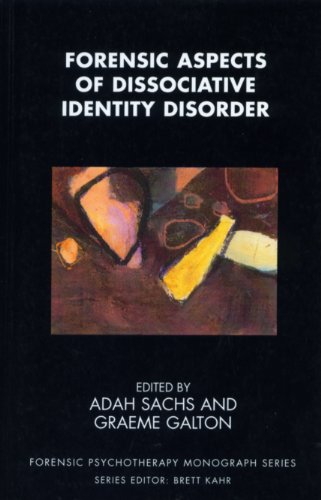
With so little training and information available to support psychotherapists working with people with dissociative disorders, there is a need for more education, more discussion, and more writing in the field of dissociation. Forensic Aspects of Dissociative Identity Disorder brings together the thoughts of professionals from a wide range of related fields, psychotherapy, psychiatry, medicine, law and law enforcement. These professionals, as well as two contributors with DID, address the complex clinical, moral, legal and ethical problems that this field presents.
In April 2008, there was a major conference in the Netherlands entitled Chronic Traumatization: Disrupted Attachment and the Dissociative Mind. The conference was the largest gathering to date in Europe to discuss dissociation, and was attended by more than 500 clinicians and researchers from all over the world. It attracted so much interest that a further 200 potential delegates could not get tickets because the conference was oversubscribed. In 2004, Ellert Nijenhuis, a keynote speaker at the conference, received from Queen Juliana the Knight of the Order of the Dutch Lion, a very high and rarely given distinction in the Netherlands. Her Majesty wished to honour him as an inspired scientist and clinician in the area of chronic traumatization. This shows how seriously dissociative experiences are taken in the Netherlands, which is today the European centre of clinical, neuropsychological and psychotherapeutic research into dissociation.
In comparison, in the United Kingdom dissociation as a result of chronic trauma is not so widely understood. Fifty-five delegates from the United Kingdom attended the Netherlands conference, representing the relatively small group of psychotherapists, counsellors, and researchers in this country who are working in this field. Unfortunately, within most psychotherapy or counselling trainings, and within social work, medicine, and psychiatry, there is almost no teaching on working with dissociation or dissociative disorders. Indeed, the British Journal of Psychiatry has published only a handful of papers on the topic. This lack of knowledge has a direct impact on the clinical treatment offered to patients, prompting the National Association for Mental Health (MIND) to state,
Mental health professionals receive insufficient training on dissociative disorders and may not ask the right questions during assessment...Lack of knowledge and information may lead to misdiagnosis, particularly when people are describing symptoms that are common to other mental health problems, such as depression...Some people, who have been in contact with mental health services for years, have made astounding progress once dissociative distress was recognised and treated.
Since knowledge of dissociation is not widely available, specialist expertise in this field is also rare in the UK, with only a few centres specialising in work with patients with dissociative disorders. One of them is the Clinic for Dissociative Studies, a small specialist outpatient mental health service for children and adults from all over the United Kingdom suffering from the range of dissociative disorders. As an independent clinical provider to the National Health Service, all assessments and treatments undertaken by the Clinic are wholly funded by the NHS and Local Authorities.
Clinical studies have consistently linked dissociative symptoms with insecure or disorganised attachment patterns of behaviour and thinking. Such patterns, arising from early trauma, can best be worked on if the patient is able to develop and experience a secure attachment in the psychotherapeutic relationship. The client is enabled to deal with past attachment traumas and begin to work through their experience of abuse. The Clinic Director, Valerie Sinason, and Consultant Psychotherapists, Adah Sachs and myself, have a strong foundation in attachment theory and research and we are all registered members of The Bowlby Centre. Valerie Sinason states in Forensic Aspects of Dissociative Identity Disorder, "More important than anything else, love and positive attachments are the keys for any hope and change."
The Clinic's model of treatment varies according to the severity of the trauma and predicament of the patient. Treatment offered, whilst psychoanalytically-based, is tailored to suit the individual client and can include a mixture of therapies. At the extreme end of dissociative identity disorder, treatment involves a team approach with a key psychotherapist assigned for the patient plus a support team. This avoids secondary traumatisation to the psychotherapist and gives the patient access to a wider range of relationships. In some cases, the Clinic provides (and supports and supervises) a local therapist in addition to providing a consultant clinic psychotherapist. Experience at the Clinic means that the patient can be treated by a team in which splitting is minimised and the different fragments of overwhelming experience can be held by the different Clinic members in a way that allows the possibility of hope.
Psychotherapeutic work with people suffering from dissociative disorders raises complex issues and, especially for clinicians working in private practice, the work can feel very challenging and isolated. For example, the complexity of the therapeutic relationship can be understood when thinking about the role of crime in the traumatic personal history of most people with DID: crimes that they have endured, crimes that they have witnessed and crimes that they have committed themselves. As I explain in Forensic Aspects of Dissociative Identity Disorder, in formulating our therapeutic responses to our patients' accounts of crimes remembered from childhood, our challenge is to find a stance that is honourable both to the patient's experience and to our own uncertainty about exactly which elements of the our patients' narratives are objectively accurate in detail.
With so little training and information available to support psychotherapists working with people with dissociative disorders, there is a need for more education, more discussion, and more writing in the field of dissociation. Forensic Aspects of Dissociative Identity Disorder brings together the thoughts of professionals from a wide range of related fields, psychotherapy, psychiatry, medicine, law and law enforcement. These professionals, as well as two contributors with DID, address the complex clinical, moral, legal and ethical problems that this field presents.