



"What can the matter be?" Therapeutic Interventions with Parents, Infants and Young Children
Evidence from research and clinical practice points to the benefits of early intervention for families with young children and additional support for the increasing numbers of 'early-years' professionals caring for them outside the family home. The clinical work described in this book was undertaken mainly within the Tavistock Clinic Under Fives Service, which offers a brief treatment model for families with babies and young children experiencing a range of difficulties.
The title of our book conveys the spirit of reflective enquiry which characterises the Tavistock approach to clinical work with under fives in clinical and community outreach settings. This approach is based on the application of psychodynamic concepts and observational skills to work with families and their young children. It involves conversations with parents and detailed observation of the many communications, verbal and non-verbal, made by their children. As clinicians observe the intricacies of family relationships revealed in the consulting room, their task is to 'puzzle away' at and try to understand the meaning of what is being expressed, making use of their own emotional experience in order to work out 'what the matter can be'. The vivid way in which young children dramatise their experience within the therapeutic setting facilitates the speed with which material unfolds.
The presence of an available mind struggling to understand these often primitive communications resembles the state of maternal 'reverie' described by the psychoanalyst Wilfred Bion: the emotional containment essential for a baby's psychological and cognitive development. However, in many of the families we work with, a lack of adequate emotional containment as a result of depression, trauma, deprivation or neglect, combined with an infant's intolerance of frustration, may result in a misattunement between the primary caregiver and her baby from the early weeks of life. This book addresses the range of interventions offered to families to help redress these difficulties.
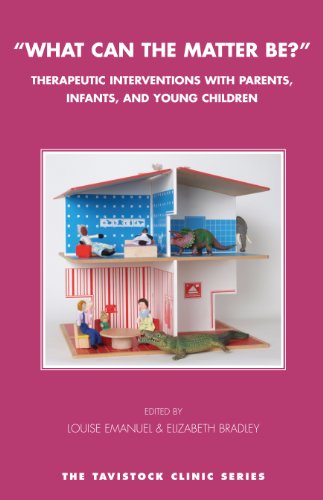
The cover illustration, an ordinary family scene invaded by the 'wild things' of a young child's imagination, indicates from the outset that the clinicians represented here are concerned with the internal as well as the external worlds of the child and his parents; how their environment and inner phantasy life impact on and influence each other. Trans-generational transmission of cultural and emotional factors may also contribute to the primitive emotional states which lurk, like the wild animals, below the surface of family life. For example, a three year old child was referred for treatment because of his terrified response to the sound of the family's doorbell ringing, hiding in fear behind the sofa. His play in the consulting room conveyed how, as an only child, he felt threatened by any intrusion of a 'sibling/rival' and fearful of being displaced by another baby. However, another level of disturbance emerged as I began exploring the parents' history and discovered that, as asylum-seekers from a war-torn land, they did indeed live in terror of the doorbell ringing in the middle of the night, with catastrophic consequences: the father had suffered torture in his country of origin and feared being returned there. In the light of this understanding we could recognise that the child was also the recipient of projections of fear from his traumatised parents, who were unable to provide containment of his primitive fears while being so overwhelmed by their own anxieties.
Much of the understanding of young children's behaviour and communications, as well as that of their parents, is based on a recognition of early infantile unconscious processes which we all resort to at times of stress or anxiety. Symptoms such as sleep problems, tantrums, crying, biting, and hair pulling may originate in very early experiences in infancy relating to lack of an adequate container for the infant's overwhelming experiences, internal and external, which might become intensely persecutory. When faced with situations of stress, to do with separation, transition, loss, as well as new and possibly overwhelming experiences of an exciting or pleasurable kind, small children may revert to these early defences, which manifest themselves in behaviour and communication difficulties. In addition, the tension between acknowledging infantile states of mind in parents, whilst simultaneously supporting their capacity to function as adults, is a recognizable feature of the work.
The book aims to capture, through vivid description of clinical material, the fluctuating shifts in attention and perspective required when working with families functioning on these many levels. In this way, it brings to life the theoretical concepts which underpin the clinical work, illustrating the clinicians' use of their counter-transference experience as a gauge of often unspoken conflicts and identifications within a family. The therapist may struggle with feelings of inadequacy and failure, receiving a 'broadcast' of anxiety from a struggling mother-infant couple, which may leave her feeling depressed and deskilled. Consultation with colleagues enables the clinician to recognise the 'force' of these projections, and to transform these experiences into meaningful understanding of the family's dilemmas.
For this reason the focus in training of clinicians is on detailed infant observation, described in the first two chapters of the book. The observer visits a baby at home, recording a detailed account of the baby's activities and interactions, and this is discussed in a seminar group. She tries to keep an open, receptive mind, describing events as they happen without attempting to theorise or make hypotheses about what she is observing. The fact that the observer has no responsibility for the care of the child and is there simply to observe is important because it means that she receives the full emotional impact of the experience, which may involve restraining the impulse to rush in and relieve a situation with 'expert' advice. This stance is an important skill for the clinician to learn in order to be receptive to the emotional states of the family and young children attending the clinic, and to think about the feelings that are evoked in her by different members of the family.
Margaret Rustin writes in her foreword 'this book is a splendid text to set out for a wide audience some of the work of an imaginative and experienced group of clinicians. The stories of the families and the intensity of parent-child relationships in the early years stay powerfully in the mind and will no doubt resonate for many. It is a pleasure to see in print a record of some of the work done over thirty years and to envisage further developments to come.' We hope that reading and applying the observational and conceptual framework set out in this book may be of help to parents, early years professionals and clinicians alike.
References
Bion, W. R. (1962a). Learning from Experience. London: Heinemann. [Reprinted London: Karnac, 1984]
Fraiberg, S. (Ed). (1980). Clinical Studies in Infant Mental Health. London: Tavistock. [Reprinted as: Assessment and Theory of Disturbances in Infancy. Northvale, NJ: Aronson, 1989.]
The title of our book conveys the spirit of reflective enquiry which characterises the Tavistock approach to clinical work with under fives in clinical and community outreach settings. This approach is based on the application of psychodynamic concepts and observational skills to work with families and their young children. It involves conversations with parents and detailed observation of the many communications, verbal and non-verbal, made by their children. As clinicians observe the intricacies of family relationships revealed in the consulting room, their task is to 'puzzle away' at and try to understand the meaning of what is being expressed, making use of their own emotional experience in order to work out 'what the matter can be'. The vivid way in which young children dramatise their experience within the therapeutic setting facilitates the speed with which material unfolds.
The presence of an available mind struggling to understand these often primitive communications resembles the state of maternal 'reverie' described by the psychoanalyst Wilfred Bion: the emotional containment essential for a baby's psychological and cognitive development. However, in many of the families we work with, a lack of adequate emotional containment as a result of depression, trauma, deprivation or neglect, combined with an infant's intolerance of frustration, may result in a misattunement between the primary caregiver and her baby from the early weeks of life. This book addresses the range of interventions offered to families to help redress these difficulties.
The cover illustration, an ordinary family scene invaded by the 'wild things' of a young child's imagination, indicates from the outset that the clinicians represented here are concerned with the internal as well as the external worlds of the child and his parents; how their environment and inner phantasy life impact on and influence each other. Trans-generational transmission of cultural and emotional factors may also contribute to the primitive emotional states which lurk, like the wild animals, below the surface of family life. For example, a three year old child was referred for treatment because of his terrified response to the sound of the family's doorbell ringing, hiding in fear behind the sofa. His play in the consulting room conveyed how, as an only child, he felt threatened by any intrusion of a 'sibling/rival' and fearful of being displaced by another baby. However, another level of disturbance emerged as I began exploring the parents' history and discovered that, as asylum-seekers from a war-torn land, they did indeed live in terror of the doorbell ringing in the middle of the night, with catastrophic consequences: the father had suffered torture in his country of origin and feared being returned there. In the light of this understanding we could recognise that the child was also the recipient of projections of fear from his traumatised parents, who were unable to provide containment of his primitive fears while being so overwhelmed by their own anxieties.
Much of the understanding of young children's behaviour and communications, as well as that of their parents, is based on a recognition of early infantile unconscious processes which we all resort to at times of stress or anxiety. Symptoms such as sleep problems, tantrums, crying, biting, and hair pulling may originate in very early experiences in infancy relating to lack of an adequate container for the infant's overwhelming experiences, internal and external, which might become intensely persecutory. When faced with situations of stress, to do with separation, transition, loss, as well as new and possibly overwhelming experiences of an exciting or pleasurable kind, small children may revert to these early defences, which manifest themselves in behaviour and communication difficulties. In addition, the tension between acknowledging infantile states of mind in parents, whilst simultaneously supporting their capacity to function as adults, is a recognizable feature of the work.
The book aims to capture, through vivid description of clinical material, the fluctuating shifts in attention and perspective required when working with families functioning on these many levels. In this way, it brings to life the theoretical concepts which underpin the clinical work, illustrating the clinicians' use of their counter-transference experience as a gauge of often unspoken conflicts and identifications within a family. The therapist may struggle with feelings of inadequacy and failure, receiving a 'broadcast' of anxiety from a struggling mother-infant couple, which may leave her feeling depressed and deskilled. Consultation with colleagues enables the clinician to recognise the 'force' of these projections, and to transform these experiences into meaningful understanding of the family's dilemmas.
For this reason the focus in training of clinicians is on detailed infant observation, described in the first two chapters of the book. The observer visits a baby at home, recording a detailed account of the baby's activities and interactions, and this is discussed in a seminar group. She tries to keep an open, receptive mind, describing events as they happen without attempting to theorise or make hypotheses about what she is observing. The fact that the observer has no responsibility for the care of the child and is there simply to observe is important because it means that she receives the full emotional impact of the experience, which may involve restraining the impulse to rush in and relieve a situation with 'expert' advice. This stance is an important skill for the clinician to learn in order to be receptive to the emotional states of the family and young children attending the clinic, and to think about the feelings that are evoked in her by different members of the family.
Margaret Rustin writes in her foreword 'this book is a splendid text to set out for a wide audience some of the work of an imaginative and experienced group of clinicians. The stories of the families and the intensity of parent-child relationships in the early years stay powerfully in the mind and will no doubt resonate for many. It is a pleasure to see in print a record of some of the work done over thirty years and to envisage further developments to come.' We hope that reading and applying the observational and conceptual framework set out in this book may be of help to parents, early years professionals and clinicians alike.
References
Bion, W. R. (1962a). Learning from Experience. London: Heinemann. [Reprinted London: Karnac, 1984]
Fraiberg, S. (Ed). (1980). Clinical Studies in Infant Mental Health. London: Tavistock. [Reprinted as: Assessment and Theory of Disturbances in Infancy. Northvale, NJ: Aronson, 1989.]