




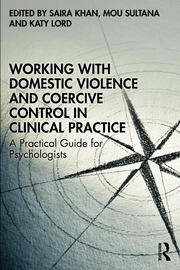
Working with Domestic Violence and Coercive Control in Clinical Practice: A Practical Guide for Psychologists
Book Details
- Publisher : Routledge
- Published : December 2026
- Cover : Paperback
- Pages : 176
- Category :
Trauma and Violence - Category 2 :
Forthcoming - Catalogue No : 98640
- ISBN 13 : 9781032788173
- ISBN 10 : 1032788178
Also by Mou Sultana
Free UK Delivery over £35



There are currently no reviews
Be the first to review

Presently, there is difficulty in finding information on how to work in the context of domestic violence and abuse in clinical practice within psychology, despite domestic violence being a significant public health concern. Working with Domestic Violence and Coercive Control in Clinical Practice argues that awareness and competence in this area are essential to good therapeutic work.
Chapters offer conclusions and recommendations from research, experience in clinical practice, survivor testimonies and consulting professionals in trauma services and the domestic violence sector. This book brings together psychological theory with an ecological and social understanding of the context in which the individual lives to provide a nuanced understanding of DVA and the dynamics of coercive control, to best support mental well-being in this context.
This book equips the practitioner with skills and offers a series of actionable recommendations embedded with knowledge about trauma and the impact of coercion, viewed through an intersectional and feminist lens that considers power in relationships and, most importantly, from a stance that resonates with survivors. It is key reading for practitioner psychologists and clinicians across disciplines to equip themselves with the latest knowledge, skills and research in this area to best support the individuals, couples, families and communities they work with.
Reviews and Endorsements
'Working with domestic violence and coercive control in clinical practice, by Saira Khan, Mou Sultana, and Katy Lord, reflects the modern position that interactions between people in family systems are the foundation for good relationships as well as for conflicts. Oversimplified views of both marital and parent-child processes can be tempting but are usually wrong. Khan, Sultana, and Lord lay out family clinical issues in all their complexity and update readers on concepts like coercive control, providing a highly informative and concise view of a broad area of interest.'
Dr Jean Mercer, Professor Emerita of Psychology at Stockton University
'This important book fills a critical gap in supporting a deep understanding of coercive control from an intersectional, trauma-informed perspective. It integrates ecological frameworks with practical clinical guidance, offering psychologists essential tools to recognise and respond to the complex dynamics of domestic abuse.'
Nic Douglas is the European Regional Manager at the Safe & Together Institute. Her 21 years’ experience in the domestic abuse field has spanned front-line service delivery, project management, and systems change work with national, European, and international reach
'In this collection of essays, Dr Saira Khan and colleagues compose a vital intervention in supporting practising psychologists to engage with families impacted by domestic abuse. Putting coercive control at the heart of the analysis and exploring the help that victims-survivors need, its counsel is rich in analytical insight. One of the key features of the book is how it explicitly places domestic abuse in a 'socio-ecological' lens, capturing how abuse may operate on multiple levels and gain support from numerous societal norms. Given the subtleties and hidden elements encountered when navigating this terrain, the profession requires a sophisticated manual, and this book is precisely that. Every practising psychologist should have a copy and keep it close at hand.'
Dr Emma Katz, Senior Lecturer in Criminology, Edge Hill University
'A powerful and well-researched exploration of the profound impact domestic abuse has on the lives of victims/survivors. It is an essential read for students and professionals working directly with survivors and those whose roles intersect with the broader field of violence against women and girls. The authors skilfully combine an extensive body of research with clinical expertise and the voices of survivors to create a compelling, informative, and accessible resource. The book highlights the critical role of practitioner knowledge in building meaningful, trauma-informed relationships that support recovery. It offers valuable insights into the systemic dynamics of domestic abuse, with a particular focus on coercive control, making it a vital contribution to the field.'
Roxana Parra Sepúlveda, MBACP (accred) MBPsS, Psychotherapist, Clinical Supervisor
'What Dr Khan and colleagues have written is a much-needed resource. While it addresses difficult material, it does so with a sense of hope and a clear advocacy for centring the voices and wisdom of survivors and victims. The book recognises the multifaceted, nuanced, and complex realities of domestic violence and abuse, and highlights the importance of an intersectional lens that engages all parts of society. As a therapist primarily supporting LGBTQ+ clients, I have found the insights within this text invaluable in strengthening my ability to support a community that is often underrepresented.'
Ed Sammons, DBT Therapist, Counsellor and Clinical Supervisor
'The growing recognition of coercive control has prompted much-needed conversations within the mental health field. This comprehensive new guidance provides consensus and clear clinical guidance on how to identify and work effectively with coercive control in therapeutic settings. It provides a ‘light in the dark’ to address treatment inconsistencies and profound ethical concerns associated with the continued oppression and institutionalised harm of victim-survivors. The authors skillfully outline the potentials of humanistic, feminist, and trauma-informed frameworks as the foundation for clinical work.'
Dr Elizabeth Dalgarno is a victim-survivor advocate, Lecturer at University of Manchester and the Founder and Director of SHERA Research Group
Table of Contents
1. The Intersection of Coercive Control and Mental Health
Saira Khan, Mou Sultana, Katy Lord
2. A Socio-Ecological Model and Intersectional Approach
Saira Khan
3. Working with Survivors in Assessment and Formulation
Saira Khan and Katy Lord
4. Facilitating Reintegration
Saira Khan
5. Different Populations Impacted by IPV: Same-sex and non-normative relationships, transgender, male survivors, and ethnicity and faith-based violence
Katy Lord
6. Working with Perpetrators
Hannah Jones and Mou Sultana
7. Recommendations
Mou Sultana
About the Editor(s)
Dr Saira Khan earned her license as a clinical social worker (LCSW) in the USA and is now a counselling psychologist in the United Kingdom. Her doctoral research focused on recovery after coercive control. She has over 20 years of clinical work experience in the public and charitable sectors across two countries and now specialises in mind-body approaches to trauma recovery.
Mou Sultana is a practising psychoanalyst at private practice in Ireland. She also works as a psychotherapist with local hospital staff members and volunteers with the probation services (adult and youth). Prior to this, she worked as a successful singer-songwriter, actress and TV presenter in India. After relocating to Ireland, she completed all three of her major degrees with distinctions such as BA Hons. in Integrative Psychotherapy, MA in Sociology, and MSc in Psychoanalytic Psychotherapy. Mou is currently undertaking her Doctoral studies at the School of Medicine in University College Dublin.
Dr Katy Lord is an HCPC registered Counselling Psychologist with extensive experience working in the NHS and private practice, delivering trauma-informed and relational psychotherapies. She has a keen interest in raising awareness of domestic abuse and identifying overt and covert patterns of behaviour that may sometimes be missed or overlooked.
Customer Reviews
Our customers have not yet reviewed this title. Be the first add your own review for this title.
You may also like
Fragments from an Extraordinary Life: Thriving on Adversity
Estela V. Welldon
Price £19.99
save £5.00

The Psychoanalyst as Revolutionary: And Other Distinguished Characters
Alan Michael Karbelnig
Price £25.59
save £6.40