



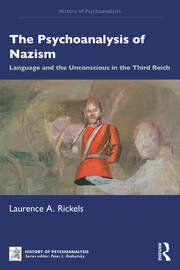
The Psychoanalysis of Nazism: Language and the Unconscious in the Third Reich
Book Details
- Publisher : Routledge
- Published : December 2026
- Cover : Paperback
- Pages : 216
- Category :
Forthcoming - Category 2 :
Psychoanalysis - Catalogue No : 98593
- ISBN 13 : 9781041333999
- ISBN 10 : 1041333994
Also by A. Laurence Rickels
Free UK Delivery over £35



There are currently no reviews
Be the first to review

The Psychoanalysis of Nazism explores the intricate relationship between psychoanalysis, language, and the sociopolitical forces of Nazi Germany.
Through a detailed examination of psychoanalytic discourse during the Third Reich, the book reveals how analysts navigated the constraints of censorship and ideological conformity, often adopting a "camouflage" style to preserve their intellectual integrity. It focuses on the works of Alexander Mette and Gerhart Scheunert, two analysts whose contrasting approaches to psychoanalysis under Nazi rule illuminate the tensions between adaptation and resistance. Mette’s mastery of linguistic subterfuge allowed him to critique the regime subtly, while Scheunert’s dual identity as both a Nazi Party member and a psychoanalyst highlights the moral and professional compromises of the era. The book also delves into postwar controversies, including Annemarie Dührssen’s polemical history of German psychoanalysis and the ongoing struggle to reconcile Freud’s legacy with the field’s troubled past.
This book is essential reading for scholars and students of psychoanalysis, history, and sociolinguistics, as well as anyone interested in the intersections of language, ideology, and intellectual resistance. It offers profound insights into the ethical dilemmas faced by psychoanalysts under totalitarian regimes and the enduring impact of these challenges on the development of modern psychoanalytic thought.
Reviews and Endorsements
'Laurence Rickels offers blazing illumination of the invisible undertow of disquiet and uncanny in our knowledge of culture, consciousness and technology. The riveting conclusions of his research are matched by his persistence and command in unveiling their implications for our here and now.'
Jonathan Lethem
'For Freud, symptoms bore the dual-imprint of conflicts between the repressed unconscious wishes on the one hand and the defences on the other that brought them about. Such compromise-formations can thus reveal something of their origins to the careful reader. This latest volume by Laurence Rickels, the acclaimed author of the monumental three-volume Nazi Psychoanalysis (2002), brings a new generation of readers back to the dark days of National Socialism in Germany and its aftermath in the post-war GDR in his exploration of the lure of Nazi ideas, particularly on the psychoanalysts Alexander Mette and Gerhart Scheunert. Rickels’s careful reading uncovers not just the resultant deformaties this wrecked in their lives and praxis, but its wider influence on psychoanalysis in Germany and beyond. In a new era where totalitarian politics is again on the rise, where strong-man ideologies flex, where truth and lies compete, and there are miriad pressure towards conformity and group-think, Rickels’s work is not just a fascinating retrospective study but consititues a particularly prescient warning from history. Thoroughly recommended!'
Roger Willoughby, clinical psychologist and historian of psychoanalysis, Gradiva Award winner, author of Masud Khan: The Myth and the Reality (2005) and Freud’s British Family: Reclaiming Lost Lives in Manchester and London (2024)
Table of Contents
Introduction
Part One: Initiation and Adaptation
1 The Ideas of March
2 Helping Handout
3 Can the Child Mourn?
4 Erziehung
Part Two: The Freudo-Marxist
1 Sisyphus
2 Leitmotif Siegfried: Walter Benjamin and Alexander Mette
3 Hölderlin and the Language of Schizophrenia
4 Dionysian Perspective
5 Banned for 998 Years
6 Ausfahrt Mette
7 On the Unconscious and in the Language of the Third Reich
8 Back in the GDR
9 Westward Ho
10 Freud in Perspective
11 Nietzsche Flunks Sociology
12 Politics and Psychosis, Commemoration and Melancholia
Part Three: The Nazi Psychoanalyst
1 The Letter
2 False and True Self
3 From Neutralization to the Masochistic Defense
4 The True Self in the Countertransference and Abstinence á deux
Conclusion: A German History of Psychoanalysis
About the Author(s)
Laurence A. Rickels analyses the condition of "unmourning" in literature, film, philosophy, and psychoanalysis across his collected work of 15 publications, beginning with Aberrations of Mourning (1988). He dislodged this concept from the traditional opposition between successful mourning and melancholia. Psychoanalysis, the Frankfurt School and deconstruction inform his perspective.
Customer Reviews
Our customers have not yet reviewed this title. Be the first add your own review for this title.
You may also like