




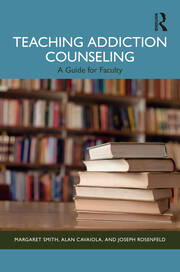
Teaching Addiction Counseling: A Guide for Faculty
Book Details
- Publisher : Routledge
- Published : December 2026
- Cover : Paperback
- Pages : 298
- Category :
Forthcoming - Category 2 :
Educational Psychology - Catalogue No : 98719
- ISBN 13 : 9781041160656
- ISBN 10 : 1041160658
Free UK Delivery over £35



There are currently no reviews
Be the first to review

Teaching Addiction Counseling introduces practical methods and techniques integral to teaching addiction courses.
Divided into four sections, this book addresses the benefits of teaching addiction in higher education, specific content courses, addiction counseling, and special topics for addiction educators such as harm reduction, behavioral addictions, and preparing students for counselor certification/licensure.
This book is essential reading for both faculty who are new to teaching addiction studies courses as well as the seasoned faculty member looking to improve their classes.
Reviews and Endorsements
‘The addiction education field has long needed a resource like this. Drawing on decades of experience, the authors have created a comprehensive, practical text that will benefit both new and seasoned educators. Their concise, accessible chapters integrate established best practices with emerging advances in the field. Particularly valuable is the book’s attention to accreditation and licensure standards, ensuring its relevance for contemporary addiction education programs and faculty alike.’
Dr. Ted McCadden, LCADC, Program Director, Community College of Baltimore County
‘This book is a comprehensive overview of the practice and implementation of teaching addiction studies courses at the college level. It provides not only practical advice in terms of negotiating the establishment and maintenance of a quality college program but, also, suggestions for the content of these courses that can aid in curriculum development. As an educator in this field for over 25 years and a former addiction program administrator, I have found this book to be straightforward and informative for both those teaching in this field and those planning to do so.’
Joan E. Standora, Ph.D, MAC, LCADC, Adjunct Associate Professor, Kingsborough Community College, City University of New York
Table of Contents
Part 1: Why Teach Addiction Education Courses: Advantages and Challenges
1. Benefits & Advantages to Teaching Addiction Education: How colleges universities and students benefit
2. TAP 21 Essentials of Addiction Education: Meeting accreditation, certification and licensure requirements
3. Challenges of Teaching Addiction Education Courses
Part 2: Teaching Addiction Education Content Courses
4. Teaching Addiction Basics
5. Teaching Addiction Neuroscience and Pharmacology
6. Teaching the Etiological Models of Substance Use Disorders
7. Teaching Co-Occurring Disorders
8. Teaching Progression and Developmental Impact Issues
9. The Importance of Multi-Cultural Considerations and How to Infuse These into Recovery Counselor Education
Part 3: Teaching Addiction Counseling Courses
10. What Students Need to Know about Ethics: How to Teach Ethics in Addiction Studies Curriculum
11. Approaches to Screening, Assessment & Treatment Planning
12. Teaching Individual Counseling
13. Teaching the Facilitation of Groups: Psychoeducational and Therapeutic
14. Teaching Couples and Family Counseling
15. Teaching Relapse Prevention
16. Teaching Motivational Interviewing
17. Teaching 12-Step Facilitated Counseling
Part 4: Special Topics for Addiction Educators
18. The Dual Role of Addiction Studies Educators: Gatekeeper vs Student Assistant Roles
19. Assessing Student Outcomes: To Test or Not to Test: Pros & Cons of Assessing Students and Program Outcomes
20. Preparing Students for Counselor Certification/Licensure
21. What Students Need to Know About Behavioral Addictions
22. The History of Recovery Services in America
23. What Students Need to Know About Drug Courts and Counseling Mandated Clients
24. Cannabis: Myths and Controversies
25. Preparing Students for Field Experience, Internship, Practicum, Or Whatever You Call It
26. The Least Glamorous Part of Addiction Counseling: Drug Testing
27. Managing Incivility and Other Inappropriate Behavior in the Addiction Studies Classes
28. Teaching Harm Reduction & Prevention: What Students Need to Know
29. Preparing Students to Become Advocates
30. Navigating your career in higher education as a faculty member- Full time, tenure-track, Adjunct, Clinical, Visiting, Lecturer, Contributing, etc.
About the Author(s)
Margaret Smith is a psychodynamic psychotherapist and group analyst working in private practice with a special interest in group supervision. She is an independent member of the United Kingdom Council for Psychotherapy (UKCP), a Member of the Institute of Group Analysis (IGA) and British Association for Psychoanalytic and Psychodynamic Supervision (BAPPS).
Alan Cavaiola is Professor Emeritus at Monmouth University in New Jersey, USA.
Joseph Rosenfeld is a professor in the Addiction Counselor Training Program within the Human Services Department at Elgin Community College in Illinois, USA.
Customer Reviews
Our customers have not yet reviewed this title. Be the first add your own review for this title.
You may also like
Queer Therapy: A Framework for Working With Queer Clients
Thomas Quinn-Smithson
Price £19.99
save £5.00

The Unconscious and the Family: The Psychoanalysis of Links and Transpersonal...
Anna Maria Nicolo
Price £36.99

The Psychoanalyst as Revolutionary: And Other Distinguished Characters
Alan Michael Karbelnig
Price £25.59
save £6.40