




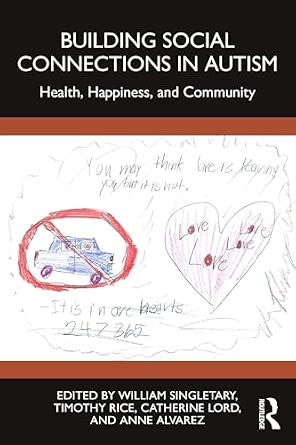
Building Social Connections in Autism: Health, Happiness, and Community
Book Details
- Publisher : Routledge
- Published : November 2026
- Cover : Paperback
- Pages : 356
- Category :
Forthcoming - Category 2 :
Psychoanalysis - Catalogue No : 98711
- ISBN 13 : 9781032961880
- ISBN 10 : 1032961880
Also by Timothy Rice

Free UK Delivery over £35



There are currently no reviews
Be the first to review

This edited work builds on contemporary empirical research concerning the central role social competence plays in wellbeing in autism spectrum disorders (ASD). Building Social Connections in Autism begins with an introduction rooted in development and explores optimal developmental processes and those of individuals with ASD.
A creative mixture of contributions from basic researchers, psychoanalytic therapists, and individuals with autism who share their subjective experience and do research in the field provides for a unique perspective. It explores the adverse subjective outcomes of these processes in individuals with ASD and expands upon the importance of social connection and includes contributions focused on psychotherapeutic interventions to build social competency and caring connections.
Clinicians, researchers, trainees, and students will benefit from this text that covers the importance of social competency in individuals with ASD with psychotherapeutic technique and research.
Reviews and Endorsements
'This book brings together eminent clinicians and researchers in the Autism field to present much needed contributions delineating emerging evidence-based approaches that are not only thoughtful but practical. There is much controversy surrounding the studies and treatment of Autism; this book offers welcomed and indispensable knowledge useful to therapists and clinicians in multiple disciplines.'
B. James Bennett, MD, Adjunct Professor Department of Psychiatry, University of Texas Southwestern Medical Center at Dallas; Child, Adolescent and Adult Psychoanalyst, Dallas Psychoanalytic Center and Center for Psychoanalytic Studies-Houston
'Among those who, like me, work with children with the autism profile, assessing and searching the best ways for promoting development in their and their family’s lives is of paramount importance. These clinicians will promptly recognize how precious this book is. Bringing together this vast array of contributions, it allows clinician to have a more holistic perspective, to gather more elements to help picking the best clinical choices, and to know more both about the autism profile group and the individual in his/her singularity. In particular, the chapter called “When an autism spectrum profile is not autism” may throw light on a vivid controversy in recent times about the advantages and pitfalls of using such a diverse category for autistic persons and the surge of so-called late diagnosis. Throughout the book, moreover, it is possible to identify an underlying thread in all chapters: the exploration of the issue of an atypical social competence (I would use the term ‘social lens’) as the core trait defining autistic development.'
Vera Regina J.R.M. Fonseca, MD, PhD, Brazilian Psychoanalytic Society of São Paulo
Table of Contents
Section 1: Introduction
1.1. Optimal Developmental Processes and Those in the Autism Profile
Section 2: Loneliness’ Adverse Subjective Outcomes and Pathways to Repair
2.1. Overview of Loneliness’ Adverse Subjective Outcomes and Pathways to Repair
2.2. Loneliness Within and Beyond the Autism Profile
2.3. Loneliness as a Risk Factor for Suicide Among Autistic Individuals
2.4. Healthcare Delivery and the Autism Profile
2.5. Attachment Representations in the Face of Autism Spectrum Disorder
2.6. The Double Empathy Problem and Social Connections
2.7. The Emergent Way of Being: Autism, Adaptation, and Belonging
2.8. Introduction to Social Competency
2.9. Social Health and Autism: Pathways to Connection on the Spectrum
Section 3: Treatments that Build Caring Connections
3.1. Introduction to Treatments that Build Caring Connections
3.2. When an Autism Spectrum Profile is not Autism: Discovering Relational Intentionality
3.3. Families and Relationship-Based Development Across our Lifespan
3.4. Helping Toddlers at Risk of Autism to Communicate with their Parents: An Audited Case Series of a Psychoanalytically and Observationally Informed Intervention
3.5. Explicating the “Moving Along Process”
3.6. Females with Autism Profiles: Theoretical Perspectives on Developmental Variability
3.7. Could There be Meaning in Repetitive, Restrictive, even Stereotypic Behaviors? Evidence of the Transmission of Intergenerational Trauma in the Psychoanalytic Treatment of a 3-year-old boy with Autism Spectrum Disorder
3.8. Making Contact on the Spectrum
3.9. Sensory Sensitivity: Defensive Avoidance or Autistic Spectrum Disorder
3.10. Mentalization Based Therapy for Autistic Children: A Relational and Developmental Model
3.11. When Medication Has a Role: A Neurologist’s Perspective on Supporting — Not Changing — the Autistic Individual
Section Four: Conclusion
4.1. Concluding Reflections
About the Editor(s)
William Singletary is a child, adolescent, and adult psychiatrist and psychoanalyst in practice in Philadelphia, PA.
Timothy Rice, MD, is assistant professor of psychiatry at the Icahn School of Medicine at Mount Sinai, New York City.
Catherine Lord is the George Tarjan Distinguished Professor of Psychiatry in the David Geffen School of Medicine at UCLA in Los Angeles, CA.
Anne Alvarez is a Consultant Child and Adolescent Psychotherapist and is retired Co-Chair for The Autism Service at the Tavistock Clinic, London. She is currently a visiting teacher and lecturer for the Tavistock Clinic, and a Lecturer on the San Francisco Psychoanalytic Society Child Programme.
Customer Reviews
Our customers have not yet reviewed this title. Be the first add your own review for this title.
You may also like

An Enduring Legacy: Revisiting Ten Forgotten Classics on Psychoanalytic...
Salman Akhtar
Price £23.19
save £5.80



The Unconscious and the Family: The Psychoanalysis of Links and Transpersonal...
Anna Maria Nicolo
Price £36.99