




The Newborn in the Intensive Care Unit: A Neuropsychoanalytic Prevention Model: Revised Edition
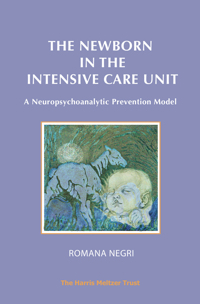
Book Details
- Publisher : Harris Meltzer Trust
- Published : 2018
- Cover : Paperback
- Pages : 400
- Category :
Child and Adolescent Studies - Catalogue No : 93574
- ISBN 13 : 9781912567300
- ISBN 10 : 191256730X
Table of Contents
Foreword
Donald Meltzer
The ugly duckling
A story by Meg Harris Williams
Introduction
Table 1: alarm symptoms
Table 2: preventive environmental actions
1. Work with the parents
The approach with parents
Anxieties about death
The narcissistic wound
The aesthetic conflict
The methodology of intervention
Interrupted pregnancy
The separation–individuation process
Catastrophic anxiety and the sense of guilt
Conclusions
2. The death of the newborn
Death at the very outset of the life
The death of the newborn
Confusion of feelings and thoughts
Odd actions and reactions
How the death of the newborn is dealt with in hospital
How parents face the grief caused by the death of their child
Bereavement
Problems encountered by staff when faced by the death of a newborn
Considerations on the sharing of the parents’ grief
Conclusions
3. Work with the staff
Work method and level
Model evolution
Theoretical discussion and presentation of the clinical experience
Phase I
The emotional atmosphere: the state of paranoid anxiety
Phase II
The concept of the neutral role
Phase III
Mirror resonance: nurses experience mothers’ and children’s feelings
Phase IV
Thinking about the work group: nurses talk about themselves
Conclusions
4. Infant observation
Methodological aspects
Difficulties of infant observation in the incubator
The first period
The child’s suffering
The child’s physiognomy
The image of the living child in the parents’ mind
The child’s states of irritability and first mental movements; object differentiation
Removal of the tracheal tube: a second birth
The child’s abrupt starting; grasping; sleep
The child’s first waking moments; the nurses start to separate from the child
The child’s first organizational patterns: 32-34 weeks
Thought formation: the integration of sensorimotor experiences and emotional experiences deriving from the object relation
The mother’s depression and its mirror-like repercussions on the nursing staff: the emotional experience modulated by the child
Splitting; the “toilet-breast”; the experience of trusting, of being contained
Conclusions
5. The neuropsychological screening of the infant before discharge from hospital
Infant examination
6. Follow-up after discharge from hospital
Neurobiological premise
The follow-up procedure
Intervention methodology
7. Psychopathological risks
Claustrophobic anxieties
Semiological elements: alarm symptoms
The parents’ role
Alarm symptoms and early psychopathology
Correlation between alarm symptoms and confirmed early psychopathologies
Multisystemic development disorders
The psychosomatic syndrome
The “minimal brain dysfunction syndrome”, or “attention deficit disturbance with hyperactivity”
Feeding disorders
Pregnancies at risk
Sleep disorders
8. Treatment of cases at psychopathological risk
The therapeutic work group
The transference with the therapist
The function of non-saturation during the session
Psychosomatic disorders and prognosis
Conclusions
9. The problems of the siblings
The birth of a sibling
The birth of a premature sibling
The risk of collusion between the parents resulting in attitudes of omnipotence and tyranny
The unresolved problems of the elder sibling
The sibling’s difficulties when the newborn suffers from cerebral palsy or a pervasive development disorder
The sibling as spectator
The sibling as an ally
Meetings with groups of siblings
Observations of the family group
Conclusions
10. The treatment and development of children with cerebral palsy
The child
The parents
A difficult development
Risks involved in the first period
The process of separation and individuation
The mothers’ group
The health providers’ group
References and bibliography
Name index
Subject index