




Ferenczi for Our Time: Theory and Practice
Part of The History of Psychoanalysis series - more in this series
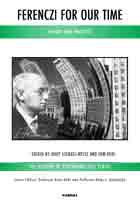
Book Details
- Publisher : Routledge
- Published : September 2012
- Cover : Paperback
- Pages : 224
- Category :
Psychoanalysis - Catalogue No : 32089
- ISBN 13 : 9781780490403
- ISBN 10 : 1780490402
Also by Tom Keve
Also by Judit Szekacs-Weisz
Sandor Ferenczi - Ernest Jones: Letters 1911-1933
Price £32.99
Free UK Delivery over £35



There are currently no reviews
Be the first to review

Ferenczi for Our Time presents contributions from British, French, American and Hungarian analysts of the second, third and even fourth generation, who deal with different dimensions of experiencing the external and internal world. These papers explore linkages between Ferenczi and the works of Winnicott, Klein, Alice, Michael and Enid Balint, the British Independents as well, as French analytical thought related to Dolto and beyond. The reader will also become acquainted with original documents of a revived Hungarian psychoanalytical world and new voices of Budapest. ‘The Balints’ chapter invites the reader to listen to colleagues sharing memories, recollections and images - allowing a personal glimpse into the life and professional-human environment of these extraordinary personalities.
The topics discussed here are wide ranging: possibilities and impossibilities of elaborating social and individual traumata, child analysis and development, body-and-mind and clinical aspects of working with psychosomatic diseases. Functions and dysfunctions of societal and individual memory are explored as signifying ‘blinded’ spots in our vision of external and psychic reality as well as the vicissitudes of generational transmission of trauma. The scope of these papers covers methodology, theory and clinical practice.
Reviews and Endorsements
'It seems that time has come to recognise and rediscover the deep influence of Ferenczi and the Hungarian School of Psychoanalysis which he founded (especially Michael, Alice and later Enid Balint) on the history and development of British psychoanalytic thought. This "emotionally attuned co-creator of psychoanalysis" inspired the work of Klein, Winnicott, Fairbairn, Heimann, Pearl King and also more recent attachment theorists, such as Fonagy and Target. Publishing the
present collection of essays - Hungarian, British and French - is a further step in the "Ferenczian renaissance", one which is going to re-integrate a partially missing link in the history of psychoanalysis.'
- Franco Borgogno, Training and Supervising Psychoanalyst of the Italian Psychoanalytical Society, and Full Professor of Clinical Psychology, University of Turin
'This volume reflects the sensitive understanding of the editors, aided by their deep embeddedness in Ferenczi's complex world - of his prolonged and ongoing influence, by his writings and, equally importantly, by his personal impact, handed down through generations. The book demonstrates that Ferenczi's revolutionary ideas continue to be eminently suited to illuminate a whole array of historical, difficult and painful human experiences, not unlike those confronted by Ferenczi. This superb collection of essays by a stellar group of collaborators will enrich the work of Ferenczi scholars as well as the perspectives of newcomers to the highly original thinking of this indelible psychoanalytic pioneer.'
- Giselle Galdi, Editor, American Journal of Psychoanalysis, and Training and Supervising Analyst, American Institute for Psychoanalysis, New York City
About the Editor(s)
Judit Szekacs-Weisz is a bilingual psychoanalyst and psychotherapist. Born and educated (mostly) in Budapest, Hungary, she has taken in the way of thinking and ideas of Ferenczi, the Balints, Hermann, and Rajka as an integral part of a “professional mother tongue”. She is a founding member of the Sandor Ferenczi Society, Budapest. The experience of living and working in a totalitarian regime and the transformatory years leading to the fall of the Berlin Wall sensitised her to the social and individual aspects of trauma, identity formation, and strategies of survival. In 1990, she moved to London, where, with a small group of psychoanalysts, therapists, artists, and social scientists, she founded IMAGO East West and later the Multilingual Psychotherapy Centre (MLPC) to create a space where diverse experiences of living and the changing context and language in different cultures can be explored and creative solutions found. She writes about body-and-mind, trauma, emigration, changing context, and social dreaming.
More titles by Judit Szekacs-Weisz
Tom Keve lives and writes in Hampstead, London. Born in Budapest, he came to England as a refugee in 1956. A scientist by profession, with a Ph.D. from Imperial College, he is a Fellow of the Institute of Physics. Having travelled much and lived for a number of years in the United States, Holland and France, as well as England and Hungary, he has been exposed to a variety of cultures and is fluent in four languages.
Customer Reviews
Our customers have not yet reviewed this title. Be the first add your own review for this title.
You may also like
Ferenczi and His World: Rekindling the Spirit of the Budapest School
Judit Szekacs-Weisz
Price £29.99
Axioms of Mind and Lived Experience: On Character and the Assumed
Christopher Bollas
Price £22.49
save £2.50