




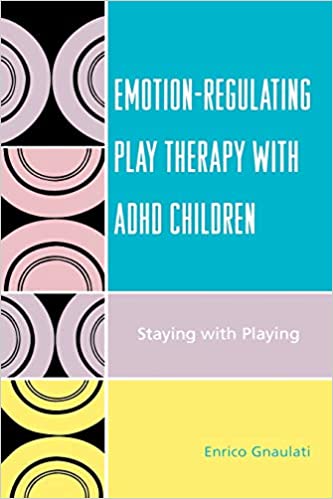
Emotion-Regulating Play Therapy with ADHD Children: Staying with Playing
Book Details
- Publisher : Jason Aronson
- Published : January 2008
- Category :
Child and Adolescent Studies - Catalogue No : 27437
- ISBN 13 : 9780765705235
- ISBN 10 : 0765705230
Also by Enrico Gnaulati

Free UK Delivery over £35



There are currently no reviews
Be the first to review

Drawing upon contemporary psychoanalytic thought, attachment theory, and the literature on children's emotional development, this book not only offers a novel conceptualization of ADHD but also a sophisticated and practical set of ideas for adapting play therapy to effectively treat it. It articulates an approach to understanding and helping ADHD children that expands and augments even as it challenges the usual neurocognitive and medicalized perspectives. The reader will appreciate the value of an energetic play process with ADHD children, encounter justifications for the therapist's liberal use of authentic self-expression and judicious mentoring for socialization purposes, be prompted to think differently about the role of interpretation and mutual enactment in child work, and locate guidelines for working supportively and caringly with parents. The book contains ample, lucid case descriptions and clinical vignettes to ground and enrich the reader's understanding of concepts and techniques. It is an essential read for mental health professionals, researches, educators and parents wishing to enlarge their understanding of ADHD.
Reviews and Endorsements
'Dr Gnaulati presents us with a refreshing new look at ADHD, both in terms of its origins and its treatments. In this work we see an exciting and hopeful paradigm shift, from an emphasis imposed by psycho- pharmacology and neurocognitive science back to a psychotherapeutic approach, one that is tailored specificially for ADHD patients. The author takes the position that ADHD emerges from early affect disregulation, the consequences of which become registered in early brain development. The treatment the author proposes is play therapy, a therapy that is characterized by the active participation and engagement of the therapist. It is the play itself rather than the meaning of the play that is crucial in the treatment. I found Dr. Gnaulati's work exciting, highly credible, well documented and hopeful. I encourage all psychotherapists to familiarize themselves with his groundbreaking work.'
- James S. Grotstein, M.D.
About the Author(s)
Enrico Gnaulati, PhD, is a clinical psychologist based in Pasadena, California, and Affiliate Professor of Psychology at Seattle University. He has authored many acclaimed books and published a host of articles in academic journals as well as popular online magazines like The Atlantic, Salon, and The Huffington Post. His work has been featured on Spectrum News, China Global Television Network, Psychology Today, and more, as well as reviewed in Pacific Standard, the Huffington Post, The Australian, and the New Yorker. He is a blogger for Mad in America, an internationally recognized reformer of mental health practice and policy.
Customer Reviews
Our customers have not yet reviewed this title. Be the first add your own review for this title.
You may also like


Identity and the Foundational Myth: Psychoanalytic Insights into Gender Distress
Marcus Evans
Price £26.09
save £2.90