




Salman Akhtar
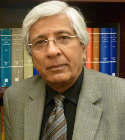
Salman Akhtar, MD, is professor of psychiatry at Jefferson Medical College and a training and supervising analyst at the Psychoanalytic Center of Philadelphia. He has served on the editorial boards of the International Journal of Psychoanalysis and the Journal of the American Psychoanalytic Association. His more than 450 publications include 120 books, of which the following twenty-three are solo-authored – Broken Structures (1992), Quest for Answers (1995), Inner Torment (1999), Immigration and Identity (1999), New Clinical Realms (2003), Objects of Our Desire (2005), Regarding Others (2007), Turning Points in Dynamic Psychotherapy (2009), The Damaged Core (2009), Comprehensive Dictionary of Psychoanalysis (2009), Immigration and Acculturation (2011), Matters of Life and Death (2011), Psychoanalytic Listening (2013), Good Stuff (2013), Sources of Suffering (2014), No Holds Barred (2016), A Web of Sorrow (2017), Mind, Culture, and Global Unrest (2018), Silent Virtues (2019), Tales of Transformation (2022), In Leaps and Bounds (2022), and In Short (2024) – as well as sixty-nine edited or coedited volumes in psychiatry and psychoanalysis. Dr. Akhtar has delivered many prestigious addresses and lectures including, most significantly, the inaugural address at the first IPA-Asia Congress in Beijing, China (2010). Dr. Akhtar is the recipient of the Journal of the American Psychoanalytic Association’s Best Paper of the Year Award (1995), the Margaret Mahler Literature Prize (1996), the American Society of Psychoanalytic Physicians’ Sigmund Freud Award (2000), the American College of Psychoanalysts’ Laughlin Award (2003), the American Psychoanalytic Association’s Edith Sabshin Award (2000), Columbia University’s Robert Liebert Award for Distinguished Contributions to Applied Psychoanalysis (2004), the American Psychiatric Association’s Kun Po Soo Award (2004), the Irma Bland Award for being the Outstanding Teacher of Psychiatric Residents in the country (2005), and the Nancy Roeske Award (2012). He received the Sigourney Award (2013), which is the most prestigious honor in the field of psychoanalysis. Dr. Akhtar is an internationally sought speaker and teacher, and his books have been translated in many languages, including German, Turkish, and Romanian. His interests are wide and he has served as the film review editor for the International Journal of Psychoanalysis, and is currently serving as the book review editor for the International Journal of Applied Psychoanalytic Studies. He has published eighteen collections of poetry and serves as a scholar-in-residence at the Inter-Act Theatre Company in Philadelphia. His Selected Papers (Vols I–X) were recently published and released at a festive event held at the Freud House & Museum in London.
Interpersonal Boundaries: Variations and Violations
Across the lifespan we may experience moments of sublime intimacy, suffocating closeness, comfortable solitude, and intolerable distance or closeness. In Interpersonal Boundaries: Variations and... (more)
The Geography of Meanings: Psychoanalytic Perspectives on Place, Space, Land, and Dislocation
This book is a multi-faceted attempt to understand the psychological mysteries of land, space, native cultures, changing eras, and geographical dislocation. It shows us that many remote and seemingly... (more)
Three Faces of Mourning: Melancholia, Manic Defense and Moving on
Mourning and the importance of the capacity to bear some helplessness, while still finding pleasure in life, are central to this tightly organized volume. The multi-faceted processes involved in... (more)
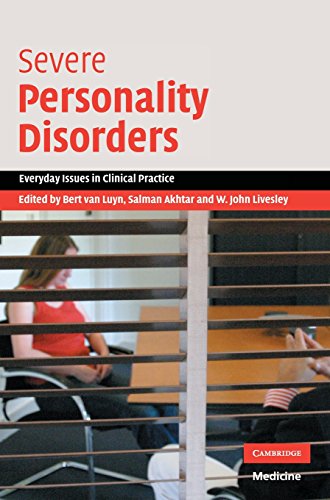
Severe Personality Disorders
This book is about understanding and managing patients with severe personality disorders. It covers biological, psychoanalytic and cognitive-behavioural approaches and provides a pragmatic guide to... (more)
Listening to Others: Developmental and Clinical Aspects of Empathy and Attunement
This edited volume addresses the critical psychoanalytic issue of effective listening. This issue has been discussed widely in the literature but most often from the standpoint of technique.... (more)

Lying, Cheating, and Carrying on: Developmental, Clinical, and Sociocultural Aspects of Dishonesty and Deceit
What constitutes a lie? What are the different types of lies? Why do people lie? Is dishonesty ubiquitous in human experience? And what should be done with individuals who seek psychotherapeutic help... (more)
The Damaged Core: Origins, Dynamics, Manifestations, and Treatment
This comprehensive and tightly argued book deals with the process through which a coherent self evolves, the various ways such development fails to occur, and the therapeutic measures to put things... (more)
Freud and the Far East: Psychoanalytic Perspectives on the People and Culture of China, Japan, and Korea
This book is a lexical ambassador with the dual responsibility of bridging the West and East and enhancing psychoanalytic conceptualization in the course of such an encounter. By juxtaposing the... (more)
The Wound of Mortality: Fear, Denial, and Acceptance of Death
Death is a much avoided topic. Literature on mourning exists, but it focuses chiefly upon the death of others. The inevitable psychic impact of one's own mortality is not optimally covered either in... (more)
Beyond the Symbiotic Orbit: Advances in Separation-Individuation
In this tribute to Selma Kramer, eminent child analyst and colleague and close friend of the late Margaret Mahler, senior analysts explore the continuing relevance of Mahler's... (more)
A Quest for Answers: A Primer of Understanding and Treating Severe Personality Disorders
This text examines severe personality disorders from various angles. It covers: diagnosis and differential diagnosis; structure and dynamics; origins and development; evaluation and triage;... (more)
The Internal Mother: Conceptual and Technical Aspects of Object Constancy
This work analyses the concept of object constancy in the light of developmental research and clinical practice. The clinical implications of disturbances in object constancy are discussed, with... (more)
The Seasons of Life: Separation-Individuation Perspectives
This work shows how, in applying Margaret Mahler's developmental framework to the life-cycle, the separation-individuation process continues, even after a degree of self and object constancy has been... (more)
Intimacy and Infidelity
Contents include: Fidelity: from cannibalism to imperialism and beyond; intimacy and individuation; egocentricity. (more)
Broken Structures: Severe Personality Disorders and Their Treatment
This book integrates psychiatry and psychoanalysis to present deeper and sounder clinical profiles of the personality disorders than have been hitherto available. (more)
Brothers and Sisters: Developmental, Dynamic, and Technical Aspects of the Sibling Relationship
Sibling relationships and rivalry are as old as recorded history. This analysis explores that ambivalence between siblings, which casts its shadow throughout people's lifetimes and affects their... (more)
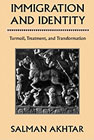
Immigration and Identity: Turmoil, Treatment and Transformation
Why do people migrate from one country to another? What is the difference between an immigrant and an exile? What determines the psychological outcome of immigration? Can one ever mourn the loss of... (more)
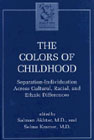
The Colors of Childhood: Separation-Individuation Across Cultural, Racial and Ethnic Diversity
Starting from a separation-individuation perspective, this text discusses cultural issues in child rearing and clinical practice. Included are chapters on African-American, Japanese, and South... (more)
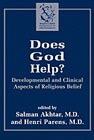
Does God Help?: Developmental and Clinical Aspects of Religious Belief
Can psychoanalysis lead us toward understanding the roots and nature of religious belief? In this text, five classical psychoanalysts representing five different religious faiths share their... (more)
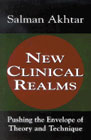
New Clinical Realms: Pushing the Envelope of Theory and Technique
Focusing on facets of mental functioning and psychopathology that remain largely unrecognized in psychiatric and psychoanalytic literature, this work raises intriguing questions about man's... (more)

Escuta Psicanalítica: Métodos, Limites e Inovações
A célebre paciente de Joseph Breuer, Anna O., denominou a psicanálise como “a cura pela fala”. Ela estava correta porquanto a psicanálise realmente posiciona o intercâmbio verbal no centro do palco.... (more)

Fatherhood Scenarios: Development, Culture, Psychopathology and Treatment
Fatherhood Scenarios offers a wide range of perspectives, including different cultural and ethnic perspectives and chapters considering the role of the father throughout the lifespan, including... (more)
Selected Papers of Salman Akhtar
Salman Akhtar is a Professor of Psychiatry, a Training and Supervising Analyst, a member of numerous editorial boards, winner of many awards, including the highly prestigious Sigourney Award, a... (more)
Food Matters: Biopsychosocial Perspectives
Food matters because food is essential to sustain life, and food matters are complex and wide-ranging, encompassing the symbolic as well as the practical. The rich discussions of the relationship... (more)
Besides Family: Extending the Orbit of Psychic Development
With contributions from Salman Akhtar, Patricia Boguski, Ann Eichen, April Fallon, Theodore Fallon, Jr., Rama Rao Gogineni, Mark Moore, Sonja Ware.
Collectively authored by psychoanalytic... (more)
Textbook of Applied Psychoanalysis
The Textbook of Applied Psychoanalysis is a unique and original contribution to the field of psychoanalysis. Emphasizing and underscoring the need for interdisciplinary discourse in understanding the... (more)
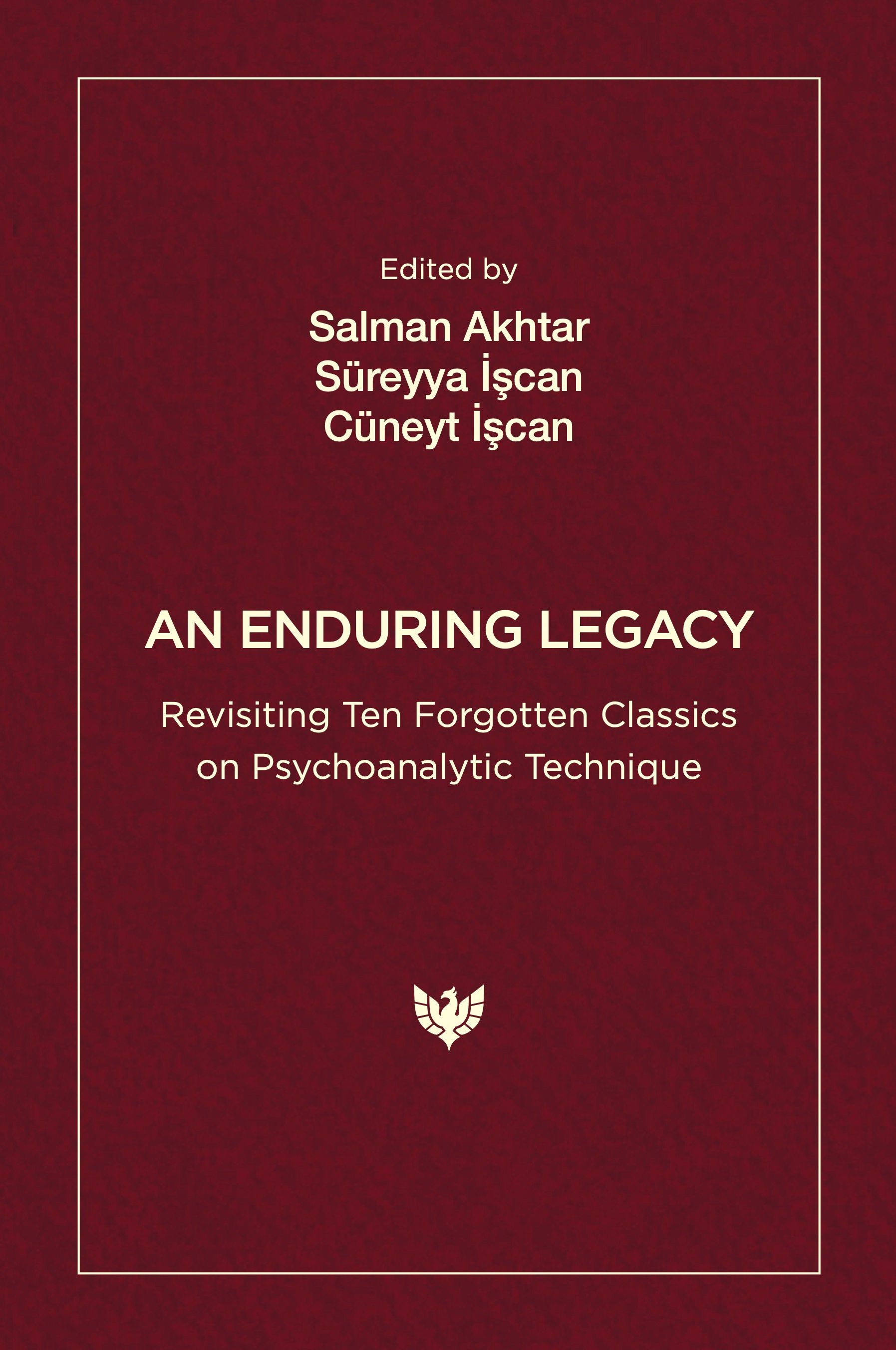
An Enduring Legacy: Revisiting Ten Forgotten Classics on Psychoanalytic Technique
Ten classic psychoanalytic papers that had a significant influence on current psychoanalytic process are returned to the fore. They represent a diversity of voices and perspectives, ensuring a... (more)